Key Takeaways:
- Financial advice falters because money decisions are 90% emotional.
- Your money behavior was shaped long before you got your first paycheck.
- A budget is a receipt. It doesn't train the instinct that made the decision.
- Financial confidence is a reflex you can build under pressure.
- The gap between knowing and doing is the real work.
Your credit score and emergency fund are exactly where they should be, but your anxiety about money hasn't gotten the memo.
That gap, between what you've done right and how you feel right now, is where conventional financial advice runs out of answers. It hands you the mechanics: the automated transfers, the budget templates, the debt payoff calculator. But what happens when the anxiety persists anyway?
Most people can't stay on budget through sheer determination alone — it doesn't address what's actually driving the decisions. You can't stick to a budget for the same reason you can't think your way out of a fear of flying. You don't math your way out of a feeling.
Here's what the research actually shows: money decisions are 90% emotional and 10% mathematical. Which means the fundamentals are the easy part, and you've already handled those. What now?
"Money isn't everything, but everything is money." - Jenny Just
Why Doesn’t Financial Advice Work?
According to a 2026 study from the financial literacy app, Zogo, 70% of those surveyed say they're stressed by financial education. And there’s a simple reason why this type of traditional advice doesn't always land: it has one move. Give you the information and assume the behavior follows. It doesn’t.
Most of what you believe about money, you learned before you were old enough to question it — the family that never discussed finances at the dinner table, the one that discussed nothing else, the message spoken or inherited that certain kinds of wealth were for other kinds of people.
Your money mindset is a high-speed feedback loop of every instinct, bias, and financial lesson you've ever absorbed. It’s the reason asking for more feels harder than it should. The reason you justify every splurge or how you can confidently talk a friend through a financial crisis and then avoid logging into your bank app for a week.
Layer on a lifetime of messaging that taught you to make yourself smaller in the rooms where financial decisions were made and you start to understand why financial confidence is especially hard-won for women.
The Training Ground You Were Never Offered
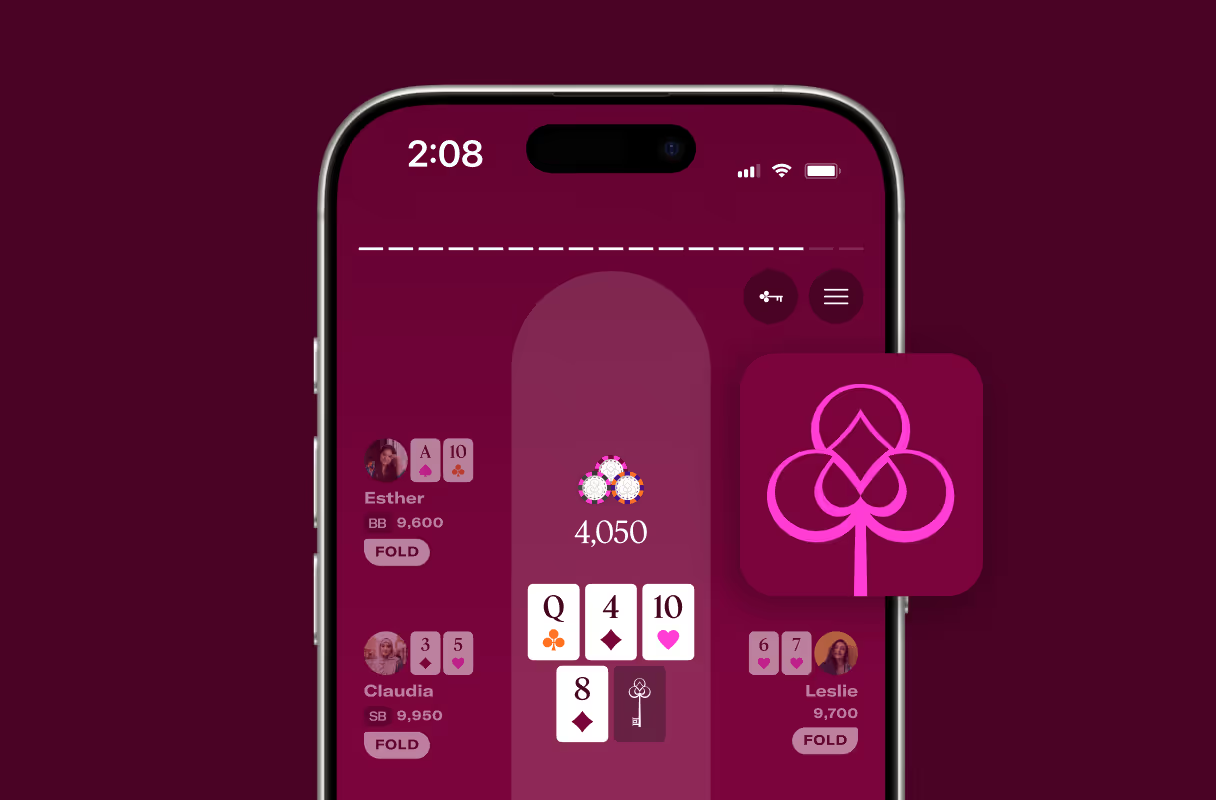
Closing the gap between what you know and what your instincts do under pressure requires practice; the kind that puts you in high-stakes conditions repeatedly, with real feedback, before it actually counts. That’s exactly what poker develops, hand after hand, in real time.
The table replicates the conditions of every high-stakes financial moment you'll ever face: incomplete information, time pressure, the temptation to act on feeling rather than read. You don't know what the other person is holding. You have to decide anyway. And then you get immediate data on whether your read was right.
A budget tells you what happened after the fact. The table trains your instincts before the moment arrives: in the salary negotiation where the offer lands and the room goes quiet, at the car dealership when the salesperson says "this is the best I can do," in the conversation with yourself about whether a financial risk is worth taking.
Under pressure, financial uncertainty feels the same whether you're at a poker table or across from a hiring manager. Practice in one environment and you're building the muscle for the other.
5 Moves to Read Your Own Table
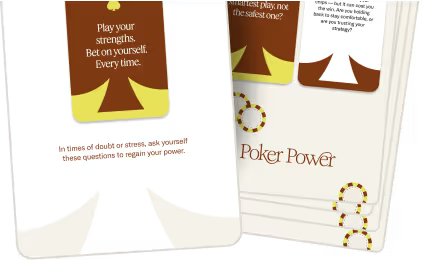
The Financial Board Review is a 10-point financial health checklist built around strategic curiosity — ten areas of your financial life, each one linked with a specific next move you can make today (sans shame spiral).
Even before you download it, get ahead by:
- Writing down your first memory of money. The actual moment, not a lesson someone taught you. What did it feel like? That memory is doing more work in your financial life than your credit score is.
- Resetting between hands. In poker, you learn to return to neutral before the next decision. This doesn’t ignore what just happened, but keeps it from making your next move for you. If that memory landed with some weight, that's useful information. Note it. Then set it down.
- Confirming the number you’re avoiding. The balance, the debt total, the savings gap. Whatever you've been approximating in your head instead of looking at directly. Avoidance is expensive. Specificity is free.
- Naming one financial pressure point. Get curious about a specific situation, money emotion, or financial conversation that reliably trips you up. A pattern you can see is a pattern you can work with.
- Making a move in the next 72 hours. Not a plan. Not a resolution. One specific, named action — a phone call, a transfer, a conversation you've been postponing — that changes something concrete about your financial position.
The checklist takes it further. But these three moves cost nothing to start now.
Playing For Keeps
The financial advice industrial complex is very good at one thing: making you feel like the problem. Your morning latte was never the villain; it was just the easiest thing to blame.
You've got better instincts than you've been given credit for. The table is where you sharpen them.
Download the Financial Board Review and start playing for keeps.

FREE DOWNLOAD
Read Our Confidence Guide
By proceeding you consent to receive marketing communications (such as newsletters, blog posts, webinars, event invitations, and new product updates), and targeted advertising from Poker Power from time to time. You can unsubscribe from our marketing emails at any time by clicking on the "Unsubscribe" link at the bottom of our emails. For more information on how we process your personal information and what rights you have in this respect, please see our Privacy Policy and Terms of Service.