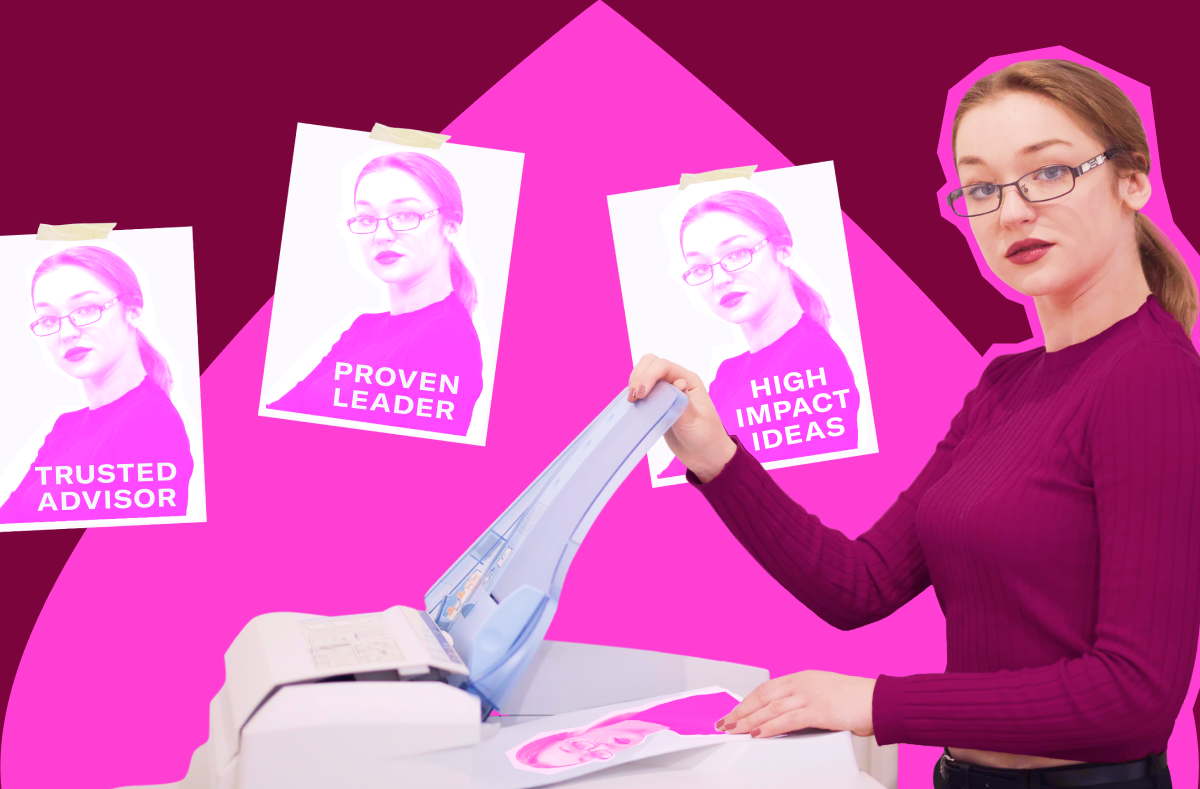
Key Takeaways:
- Many of us were taught to be good at things but not to talk about them.
- Those who struggle to take credit are often the ones with the most to claim.
- Staying silent about your results isn't modesty. It just undercuts your work.
- Sharing facts is almost always more persuasive than making general declarations.
- For more visibility, name the problems you solve, not the credentials you hold.
Have you ever learned how to talk about yourself? Or has your focus been to simply be good at things and wait to get noticed? Spoiler: the women who find self-promotion the hardest are frequently the most capable people in the room. Yet, they are often completely fluent in everything except talking about themselves. Self-promotion involves expressing out loud things that can feel, frankly, like they belong in someone else's mouth.
Take Kristin, for example. She built LOKK Designs after a decade of being, as she put it, “the fixer”. Everywhere she worked, she was the one who caught what everyone else missed, fixed what nobody wanted to own, and made the whole thing run smoothly. She was exceptional at her job in a way that was visible to everyone; used constantly, credited rarely.
"They wanted my skills, not my voice," she said.
Six words, and they capture so much about how most organizations run: the work gets seen; the person behind it often doesn't. And when someone in that position is finally asked to advocate for themselves — in a job interview, pitch, or funding application — they struggle. Their results are real. It’s just that nobody ever asked them to narrate them before.
On the surface, this reads as a confidence problem. But not being able to effectively sing your own praises is more rooted in finding the right language than undervaluing your own work.
In poker, knowing your hand's value is only half the information you need. You also have to decide how to represent it at the table: how you play it, and what your moves signal to the people watching. A player who holds a strong hand but plays it small isn't expressing accurate information. She's actively obscuring it. And the table responds accordingly.
Visibility works the same way. Self-promotion can feel like lying because you've been trained to equate modesty with integrity. Speaking plainly about your value feels like overclaiming. That's your conditioning talking — not reality.
Three moves that can shift your mindset:
- Report, don't declare. "I built the system that reduced onboarding time by 40%" lands differently than "I'm really good at operations." One requires you to assert something about yourself; the other asks you to report something you achieved. The facts are identical. Your delivery will do the heavy lifting.
- Name the problem, not the credential. "I'm an excellent administrator" is a claim. Naming a problem that exists and demonstrating how you solved it is market positioning. The visibility comes from accurately describing the situation, not from implying your talent.
- Treat silence as a signal. When you don't put your name on the work, wait to send the follow-up, or fail to mention the result, you're not being modest. That sends a specific signal. The table reads it as: the work didn't happen, or the person who did it doesn't think it matters. Silence, in this instance, is not neutral.
It took a layoff to force the question for Kristin, and once it did, the answer was straightforward. She built LOKK Designs for every woman who'd been the carrier who kept everything running while someone else held the title. The visibility she'd withheld at work, she put into her business. LOKK Designs became the first place she ever accepted full credit for what she built
That, she said, felt like finally playing her hand.

FREE DOWNLOAD
Read Our Confidence Guide
By proceeding you consent to receive marketing communications (such as newsletters, blog posts, webinars, event invitations, and new product updates), and targeted advertising from Poker Power from time to time. You can unsubscribe from our marketing emails at any time by clicking on the "Unsubscribe" link at the bottom of our emails. For more information on how we process your personal information and what rights you have in this respect, please see our Privacy Policy and Terms of Service.