
You and your co-founder just landed your first big client, and you're texting each other about the next hire before the call even ends. That's the moment, mid-momentum and feeling good about the company you're building, to also put your exit terms in writing. It's the same deliberate thinking that got the two of you this far.
A well-run poker table settles its rules before the first hand: what everyone buys in for, and what happens if someone needs to leave early. Every person at that table agrees to those terms before the chips come out. Founders get the same window, right at the start — before the first hard call neither of you saw coming.
Structuring what happens if one of you leaves, while the partnership is thriving, is the same discipline that makes it thrive in the first place: the clarity that keeps a future disagreement small so you can define (and keep) the partnership on good terms.
The Conversation That's Easiest to Have Before You Need It
Every document with "agreement" in the name sounds like something you'll need someday, which makes it easy to let it slide behind the product work and whatever's most pressing on the calendar this week.
But starting a company required a string of calculated decisions: what to build, and how much of your runway to risk finding out whether it would work. Deciding how you and your co-founder split ownership, authority, and an eventual exit means using that same strategic thinking to help the two of you, not just the business you're building.
Some people call the resulting document a founder breakup plan. Handled early, while you still like each other, it's one of the smartest, most self-assured moves two aligned partners can make.
Five Terms Your Operating Agreement Can't Skip
Drawing on guidance from trusted accelerators like Y Combinator, here are the five co-founder agreements worth laying on the table now.
- Split Ownership Strategically
Decide deliberately what percentage each of you owns, and write down why.
Per Carta's 2026 Founder Ownership Report, most multi-founder teams don't split ownership perfectly evenly, though even splits are becoming more common — up to 27.3% among three-founder teams last year, up from 21% the year before. The right split comes from a real process: noting who's carrying the most risk, who's contributing the most right now, and who joined later, then landing on a number you can both explain in one sentence a year from now.
- The Vesting Schedule Nearly Every VC-Backed Company Uses
Once you agree on the split, have that ownership earned gradually, on a schedule you set ahead of time.
The industry default, independently confirmed by Carta, venture capital firm CRV, and Stripe's own founder guidance through Stripe Atlas, is a four-year vesting period with a one-year cliff. Under that structure, no equity vests during the first twelve months. At the one-year mark, 25% vests all at once, and the remaining 75% vests monthly over the following three years. Carta's own data puts adoption of this exact structure at roughly 94% among VC-backed founders and employees, about as close to a universal default as founder terms get.
CRV frames the reason plainly: roughly one in four two-founder teams loses a co-founder within four years. Vesting is what keeps a founder who leaves early from walking away with a large, permanently unearned stake in a company they didn't stay to help build.
- Decide Who Has Final Say on What
Identify, in advance, which decisions need both of you and which one person can make alone in their own area.
A workable split usually looks like this: day-to-day calls in your own lane (who you hire, what ships in the product) belong to you alone. The handful of decisions that can reshape the company (raising money, bringing on a new co-founder, selling the business) need both signatures. Write the list down now, while you're both calm and the decisions are still hypothetical. That's what keeps you from drafting it for the first time in the middle of a real disagreement.
- Set Your Exit Terms
Agree on what happens to a departing partner's equity, and how the company buys it back.
At minimum, put three answers in writing: what happens to unvested equity if someone leaves early (it typically returns to the company under the vesting schedule you set), a formula for valuing a departing partner's vested shares so neither of you has to negotiate it under pressure later, and a clear timeline for completing the buyback.
- An Agreed Way to Disagree, Decided in Advance
Pick who you'll both go to if you can't agree, while you're both calm enough to choose well.
That might be a set cooling-off period before either of you act on a disagreement, a trusted advisor or mentor you both respect, or a mediation clause written directly into your founder agreement. The mechanism matters less than the timing: choosing it together, in a calm environment, well before you need it.
This Is What Confidence Looks Like on Paper
There's a reason the rules at the poker table are set before the cards are dealt. Do the same for your partnership: pick a date this month, and write the terms together while you still like each other enough to make it easy. Two founders who can calmly divide up a company with zero problems yet are exactly the two founders equipped to handle whatever comes later.
Call it the most confidence-inspiring paperwork you'll draft all year.


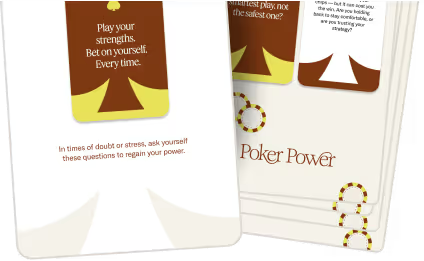
FREE DOWNLOAD
Read Our Confidence Guide
By proceeding you consent to receive marketing communications (such as newsletters, blog posts, webinars, event invitations, and new product updates), and targeted advertising from Poker Power from time to time. You can unsubscribe from our marketing emails at any time by clicking on the "Unsubscribe" link at the bottom of our emails. For more information on how we process your personal information and what rights you have in this respect, please see our Privacy Policy and Terms of Service.