
Key Takeaways:
- AI overwhelm is a training problem, not a knowledge problem.
- Repeated, low-stakes moves build AI fluency and confidence.
- Personal use is the lowest-stakes AI entry point.
- Five practical moves to go from context-building to using AI like the 1%.
- Eight women-led voices making AI adoption genuinely accessible.
Nobody has to tell you what AI overwhelm feels like. It's the low-grade dread of reading about a tool you've never heard of, watching a demo that makes skills you spent years building look replaceable, and then closing the tab and going back to your inbox, vaguely aware of looming change and potential job instability.
But that doesn’t mean you’re “behind”.
Earlier this year, Andrej Karpathy, co-founder of OpenAI, the person who coined "vibe coding", said on the No Priors podcast that he watches what people are building and feels "very antsy" he's not keeping up. If that's the experience at the frontier, the overwhelm you're feeling is proportionate. The move is choosing where to focus next.
At a fast table, the players who stay in the game have trained their relationship with uncertainty and incomplete information. This table confidence and AI fluency compound the same way — hand after hand, until the read is second nature.
Why Personal Use May Be the Least Intimidating AI Entry Point
The professional applications of AI tools and systems feel high-stakes because they are. The impacts are real: automating a workflow, building prompts for your business, integrating tools into how your team operates — you're potentially changing how you work, bill, and run.
Personal use doesn't carry that weight. Ask AI to plan a dinner party menu around what's in your fridge or have it organize every book note you've taken this year.
These interactions build the same underlying skills — giving context, asking better questions, evaluating outputs critically — without the professional stakes that make experimentation feel loaded.
The poker translation: you don't sharpen your reads at the final table. You build them hand after hand, so the instinct shows up when you need it.
Five Ways to Integrate AI Into Your Life Right Now
Pick the one that earns a try this week.
1. Train it to sound like you.
Most AI output sounds like AI because people skip the voice step. Before you ask it to write anything, spend ten minutes showing it how you write. Paste three emails or posts you're proud of. Tell it what you never say, what you always say, and what your reader needs to feel by the end. That investment pays every time you open a new conversation.
2. Prompt building: Brief it like a colleague.
Some people use AI like a search engine: short query, scan the results, close the tab. Better prompts give the tool a role, a context, a format, and a constraint. Skip "help me write a follow-up email" and try: "You're a sales consultant with 15+ years of experience in my industry. Write a follow up email to a client who went quiet after our proposal. Confident tone, not pushy. Under 100 words." The output changes entirely when the instruction is that specific.
3. Use it as a mirror, not just a tool.
The prompt worth adding to your rotation is about pattern recognition. After a meeting, a decision, or a tough conversation, open a chat and debrief. (Bonus points if you can upload your meeting notes or recording.) What did you commit to? Where did you talk too much or not enough? What did the room need from you that you didn't give it? Over time, ask it to identify patterns in how you work, communicate, and make decisions. What does your prompting style say about where you get stuck? Where do you ask for help versus push through alone?
The players who improve fastest are the ones who study their own hand after every game.
4. Borrow moves from the top 1% of AI users.
The AI layers most people never reach are where it gets interesting. Plugins let you package your expertise — your voice, your judgment, your institutional knowledge — into a reusable brief your whole team can draw from. Cowork runs workflows directly on your machine while you're in meetings, sleeping, or living your life. Dispatch lets you trigger all of it from your phone. Give one prompt before you leave for the day, and come back to your next project drafted, organized, and ready to present when you log back in.
5. Curation over consumption: Build a feed that signals.
One of the real drivers of AI overwhelm is a content problem. If your social feed is full of debates about the latest model release or predictions about the end of work as we know it, you're not consuming the same level of value. The signal is elsewhere. Below are eight places to find it.
Eight Women in AI Voices Worth Following
These aren't AI influencers pretending to be experts. They're knowledgable AI practitioners who've figured out something genuinely useful and are sharing the method in public.
- Allie K. Miller · Instagram · @alliekmiller Former Amazon AI leader turned educator. Miller breaks down enterprise AI in a way that makes sense outside the enterprise — concrete use cases, zero condescension.
- Sabrina Ramonov · TikTok · @sabrina_ramonov Forbes 30 Under 30 and founder of Blotato, Ramonov has built a 2M+ following by teaching entrepreneurs how to run AI systems at the scale of a full team — solo. Her tutorials are highly specific: she shows her own dashboard, her own content volume, her own automation stack. Worth following for anyone who learns better from seeing the proof than reading the premise.
- Cat Goetze · Instagram · @askcatgpt Goetze specializes in making AI tools approachable for people who didn't grow up in tech. Her content on building personal AI workflows from scratch is a particularly strong starting point.
- Cassie Kozyrkov · Substack · Decision Intelligence Former Chief Decision Scientist at Google. Kozyrkov's newsletter covers how to think about AI outputs critically — the skill that separates useful AI adoption from lazy AI dependence.
- M(AI)VENS · Substack · womenai.substack.com A newsletter built for the gap: women in AI, covering tools, research, and the systemic context most AI coverage leaves out.
- Elena Verna · LinkedIn + Newsletter · Elena's Growth Scoop One of the sharpest growth strategists publishing right now. Verna's AI coverage is grounded in real application — she tests these tools in live work and shares what moves the needle.
- Emily Kramer · Substack · MKT1 Newsletter Framework-heavy marketing strategy that treats AI as infrastructure. Strong read for anyone in marketing, product, or early-stage companies.
- Marina Mogilko · Instagram + YouTube · @siliconvalleygirl Covers tech, startups, and AI through the lens of someone building in public. Her YouTube channel is particularly strong for visual learners who learn faster by watching than reading.
Build Your AI Confidence
The game doesn't pause while you prepare for it. Get one play in this week — a personal project, a context brief, two names on the list above — and let the instincts build from there.
We're researching the gender AI gap — and we want your data in the mix.
→ Take the Survey and tell us what you want to learn about AI.


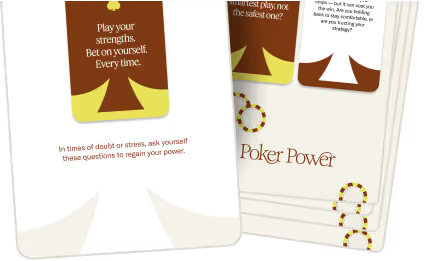
FREE DOWNLOAD
Read Our Confidence Guide
By proceeding you consent to receive marketing communications (such as newsletters, blog posts, webinars, event invitations, and new product updates), and targeted advertising from Poker Power from time to time. You can unsubscribe from our marketing emails at any time by clicking on the "Unsubscribe" link at the bottom of our emails. For more information on how we process your personal information and what rights you have in this respect, please see our Privacy Policy and Terms of Service.
.webp)