
How many times have you sat there, head in your hands, shouting into the void, hoping your big purpose would be revealed—that single, unmistakable thing you were meant to do. You’ve probably Googled "career pivot" more times than you can count.
These moments don’t happen by accident. They’re a desire for something larger. But finding fulfillment, especially in an AI-enabled world, requires strategy. It demands self-knowledge and the ability to act on intuition with incomplete information.
The Japanese offer a proven roadmap for this quest, captured in a single concept: Ikigai.
The Ikigai Framework: A Purpose Audit
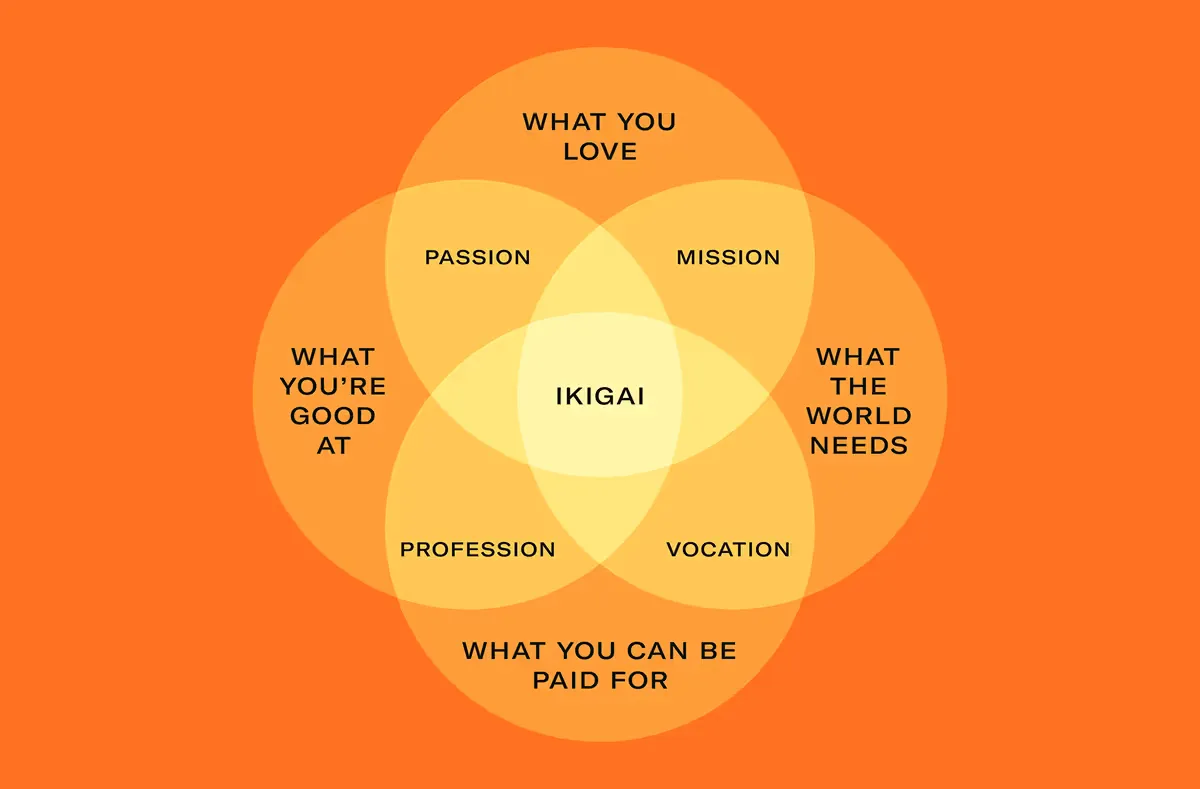
Ikigai (pronounced ee-key-guy) translates roughly to "a reason for being" or "that which gives your life worth." It isn't some mystical secret; it’s a practical framework for analyzing your life’s direction. It sits at the sweet spot where four core elements overlap:
- What You Love
- What You Are Good At
- What The World Needs
- What You Can Be Paid For
When all four circles intersect, you discover your Ikigai.
Sounds like a lot of introspection, right? It is. But if you’re looking for a low-stakes training ground for the decision making and emotional intelligence required to navigate these four circles, you’ve already found it: the poker table.
The Poker Parallel: Sharpening Each Element
Imagine calling an all-in bet at an experienced poker tournament? That's just a warm-up. The skills you learn at the poker table are the same ones you can use to map out your life and career trajectory. Consider it your new personal playbook for purpose.
Here's how playing poker helps you excel at each piece of the Ikigai puzzle:
1. Passion: Confidence in Doing What You Love
What activity makes you lose track of time? The original question asks what you love, but the real challenge is having the confidence to pursue it.
In poker, confidence isn't bravado, but the quiet assurance that your process is sound. You develop it by practicing, testing your reads, and owning your decisions, whether they result in a win or a loss. This self-security gives you the grounding to step away from the career path you should want and move toward the one you truly desire. You stop apologizing for your ambition.
2. Vocation: Resourcefulness to Know What You Are Good At
Figuring out what you excel at requires objective self-assessment. Are you great at math? Reading body language? Staying patient for long periods? This is your strongest source of resourcefulness.
Poker demands you inventory your strengths constantly. If your opponent is predictable, you exploit that. If you struggle with tilt, you adjust your game or walk away. You learn to be resourceful with the tools you have: your chip stack, your position, and your psychological state. This practice forces you to identify, appreciate, and deploy your objective skills in a competitive setting.
3. Profession: Taking Risks You Can Be Paid For
A profession is where skills meet market value. To find this, you must analyze your ecosystem, calculate the potential return on your time, and understand when to invest big, or fold gracefully. This is pure risk assessment.
Poker teaches you to define and manage risk, not fear it. Every hand is an exercise in Expected Value (EV): Will this decision pay off in the long run? By learning to calculate the odds and factor in probability, you train your mind to stop making gut decisions and start making fact-based bets on your career and financial future.
4. Mission: Developing the EQ to Know What the World Needs
This circle is about external awareness — understanding systems, identifying gaps, and knowing how your work impacts others. This is the definition of Emotional Intelligence (EQ).
Poker is a masterclass in EQ. You’re not playing against the cards; you’re playing against people. You need to read subtle cues, identify fear or confidence in your opponents, and adjust your strategy based on their psychological state. This ability to read the room — to assess the needs, motivations, and pressures of the people around you — is non-negotiable for leadership, negotiation, and finding your societal contribution.
Turning Strategy into Practice
The difference between an idea and an action plan is simple: structure. Use these practical, poker-inspired micro-exercises to start building towards your Ikigai:
- For Confidence: Every morning for the next three weeks, write down one career risk (a tough meeting, an aggressive proposal, asking for a raise) you're avoiding. Then, identify the smallest possible action you can take on it today. This is your "check", a low-cost assessment of the situation.
- For Emotional Intelligence (EQ): The next time you're in a meeting, practice "reading the table" instead of just talking. For five minutes, say nothing. Observe who speaks first, who defers, who interrupts, and who shows non-verbal frustration. Use that data to inform your next contribution.
- For Resourcefulness: List your professional and personal strengths. Next to each one, write down one unexpected, high-leverage way you could use that skill this week. (e.g., Strong public speaking > Volunteer to run the weekly team agenda instead of just attending.)
- For Risk Assessment: Apply the concept of Expected Value (EV) to a major life decision (e.g., getting a certification, taking a job). Write down the potential outcomes, assign a probability (e.g., 70% chance of success), and weigh the financial/time cost. Does the potential reward outweigh the calculated risk?
Clear Takeaways: Your Internal Anchor
In a fluid professional environment where adaptability is the most valued currency, finding your Ikigai gives you an internal anchor. Poker is the most dynamic training tool for building that anchor.
You don't need to quit your job or spend years traveling the globe to find your purpose. You just need a practical way to develop the mental fortitude required for the search, and develop the decision-making discipline that separates the successful from the stalled. Time to turn anxiety into action.

FREE DOWNLOAD
Read Our Confidence Guide
By proceeding you consent to receive marketing communications (such as newsletters, blog posts, webinars, event invitations, and new product updates), and targeted advertising from Poker Power from time to time. You can unsubscribe from our marketing emails at any time by clicking on the "Unsubscribe" link at the bottom of our emails. For more information on how we process your personal information and what rights you have in this respect, please see our Privacy Policy and Terms of Service.